I am the kind of person that prefers a good, deep conversation to small talk. One of my favourite parts of my former job was interviewing people. It's a challenge (albeit a fun one) to figure out what questions to ask in order to learn something that you want to learn about someone. I loved asking questions like "How did that affect you?" or "Why did you choose this over that?" It's these kinds of questions that help you understand a more of a person's inner motivation and goals and desires. It's these kinds of conversations that help you really get to know someone, or feel like you're known and understood.
When I first arrived here, it was a bit awkward to be in stores, or sometimes in public in general. I look like I could be dutch, so why would anyone guess that I didn't speak the language. (This post was how I felt when I first arrived.) My first mission was to learn the basics. "Thank you", "please", "How much does this cost?", "bicycle", telling time, colours, furniture... these are some of the first things I learned. I felt (and still do, at times) like a child, because of the level of my dutch language. That's not a bad thing. This is how you learn.
As I've been paying more attention to the dutch language around me, and thinking in dutch sometimes, and communicating in dutch sometimes, I find myself really wishing that I could make small talk with people! (I never thought I would say that.) I wish I could think quickly enough to say "excuse us, he's just excited to see so many new things", or "don't worry about it", or "blowing raspberries is his way to say that he's trying to talk to you" but even more than that, I wish I could joke with people (especially strangers.) It's the little phrases like this, and short communication that help people decipher between a good or bad attitude. [When using small-talk, or joking with strangers, I'm very aware that a small vocabulary or grammar mistake can change the whole meaning of a phrase. I don't want to joke with strangers unless I know exactly what I'm saying, and know that it's correct and appropriate.]
I don't really care if people think I'm a serious person or if they think I'm funny or boring. I don't care if they think I have a good attitude or not. However, I think attitude is contagious. If, while standing in line waiting to check out, someone cracks a joke or comments on something that everyone notices, it can really lighten the mood, and make things just a bit more enjoyable.
It only takes one person to start a "conversation", and it doesn't even have to be about anything special! I just like knowing that even if you don't know people, it's still possible to make otherwise boring and monotonous things a little more interesting and fun, if you have the right thing to say, to the right person, at the right time. This is when I wish I could be the person to make the right joke at the right time.
I look forward to the day when I can use small-talk appropriately and effectively.
Tuesday, 25 June 2013

Wednesday, 6 March 2013
15 things
I don't like:
1) humid weather that stimulates dust mites, and makes it a bit more difficult to keep laundry smelling nice.
2) seeing Canadian geese in the beautiful park in Barneveld.
3) the radiators (and connecting water pipes) in every room, that collect dust and make it impossible to do a quick thorough clean. I still haven't figured out how to clean the inside of the radiators.
4) smelling the "fresh country scent" even before I leave the house some mornings.
5) black carpet. It looks really nice, but is it ever hard to keep clean!
I like:
1) finding feathers on my eggs occasionally. Why eggs in the EU would be illegal in America and vice versa
2) paying less than 1 Euro for 200g of brie cheese.
3) having 2-4 weeks (only) of snowy winter.
4) being able to walk into the center of town in 15 minutes, or bike there in 5.
5) the simplicity that comes with having a small house. ("Small" is relative, of course. What would be a small Canadian house is an average, or even medium-large, dutch house.)
6) more moderate weather. Spring and fall seem to be very long seasons here.
7) online shopping. Oops! A lot of websites or businesses offer free delivery (within a couple days), and I can often find better prices for certain products online. It's also a bit more difficult to lug home a large item (such as a high chair or a big box of diapers) than it is to have it delivered to my front door. Hello... this is a win-win situation!
8) eating bread every day, and knowing that it's fairly healthy.
9) hardwood & tile floors in the main living areas.
10) a good pair of all-purpose boots.
Monday, 11 February 2013
L'oven life
Baking is not a common hobby here. It's also not common as a "necessity" or a way of being more cost-effective. Baking just doesn't really happen much. Well, maybe it does, but it sure seems infrequent compared to the baking that happens in Canada.
Most meals here are made on the stovetop. They even have their own way of "slow-coking" a meal on the stovetop. Soups and potato dishes are very common, and casseroles are not.
When I moved here, I was shocked to discover how much I used an oven in Canada- even though I really didn't cook much. I was shocked when I went to make a casserole or bake some brownies (I don't remember the first meal I wanted to bake here), and these were the oven controls I had to work with. (This is an actual picture of the oven.... which was built-in. Ovens and stove-tops are sold and installed separately here.)
The nob on the left can be twisted clockwise or counter-clockwise, and it has no beginning or end point. There must be a proper term for that, but I can't think of the word right now. I discovered that one of the settings was "off" (no light, no heat and no sound), but there were 5 other settings. I bought an oven thermometer so that I could try to figure out what the other settings were. After about 3 months, I discovered that the "third click to the right" was at least consistent heat, and would cook or bake food at a reasonable temperature, so that was the only setting I used.
Then, there was the nob on the right. It says "degrees C", so it was easy to figure out what it was. However, there sure was none of this "set the oven to 350 degrees, and preheat it while you prepare the food" business. No, I would turn the oven on "3 clicks to the right", then check every 10 minutes or so to see what the inside temperature was. If it was too hot, I'd turn the temperature nob counter-clockwise, and either just put the food in and keep an eye on it, or wait until it was a more reasonable temperature. Sometimes, if I wanted to make sure that the temperature was right before putting the food in, it would take 45 minutes to heat it up to the right temperature.


After a little while, I discovered that baking is not common here. Most people buy baked goods, and like I said, most meals are stove-top meals. I have had conversations with other non-Dutch residents, and twice I have been told "Wow, you have an oven? Lucky!" Apparently an oven is not a necessity. I think most people have some kind of combination microwave/oven that would fit maybe a 10lb bird, IF you were to bake a bird (which is also not common here.)

I now have a beautiful, practially-new oven, with two dials. I can set the oven to a certain temperature, and expect it to heat up to just that temperature. I can even broil something if I want to! I have also discovered that the "3-clicks to the right" on the old oven was actually convection bake. The self-clean setting is called "steel wool with elbow grease", and I can't pre-set it to start or finish at a certain time (delayed cook). However, I know that it is a beautiful, very good-quality oven that bakes well, and I have no "undiscovered buttons." With the exception of only knowing 4 of the possible 6 settings on the oven, I can happily say that I use the oven to it's fullest potential. There is something really wonderful about that! Even more than that, I HAVE an oven. Aaah... a simple thing that I have never been more thankful for :)
Most meals here are made on the stovetop. They even have their own way of "slow-coking" a meal on the stovetop. Soups and potato dishes are very common, and casseroles are not.
When I moved here, I was shocked to discover how much I used an oven in Canada- even though I really didn't cook much. I was shocked when I went to make a casserole or bake some brownies (I don't remember the first meal I wanted to bake here), and these were the oven controls I had to work with. (This is an actual picture of the oven.... which was built-in. Ovens and stove-tops are sold and installed separately here.)
The nob on the left can be twisted clockwise or counter-clockwise, and it has no beginning or end point. There must be a proper term for that, but I can't think of the word right now. I discovered that one of the settings was "off" (no light, no heat and no sound), but there were 5 other settings. I bought an oven thermometer so that I could try to figure out what the other settings were. After about 3 months, I discovered that the "third click to the right" was at least consistent heat, and would cook or bake food at a reasonable temperature, so that was the only setting I used.
Then, there was the nob on the right. It says "degrees C", so it was easy to figure out what it was. However, there sure was none of this "set the oven to 350 degrees, and preheat it while you prepare the food" business. No, I would turn the oven on "3 clicks to the right", then check every 10 minutes or so to see what the inside temperature was. If it was too hot, I'd turn the temperature nob counter-clockwise, and either just put the food in and keep an eye on it, or wait until it was a more reasonable temperature. Sometimes, if I wanted to make sure that the temperature was right before putting the food in, it would take 45 minutes to heat it up to the right temperature.


After a little while, I discovered that baking is not common here. Most people buy baked goods, and like I said, most meals are stove-top meals. I have had conversations with other non-Dutch residents, and twice I have been told "Wow, you have an oven? Lucky!" Apparently an oven is not a necessity. I think most people have some kind of combination microwave/oven that would fit maybe a 10lb bird, IF you were to bake a bird (which is also not common here.)
Anyways, as I was getting more familiar with my oven and the food here, I began to appreciate the fact that I had something that I could use to bake with. Sometimes it's nice to just make some banana chocolate-chip muffins. The smell of the muffins, and the satisfaction of making something that you can enjoy out of a bunch of seemingly random ingredients.... yum. Yes, I was thankful to have an oven.
THEN, I got a surprise. On December 5th, actually (which happened to be Sinterklaas here), my husband brought home a new oven! (This story is really much longer, but I'll leave it at that for now.) Just the fact that he would think to bring an oven made my day... week... month. Then, we plugged it in.... YES! It worked! YES.... the temperature gauge was right! Then, we measured it (by "we", I really mean "Martin").... and yep, the measurements were just right (this is especially important when it's built-in.)
I could go on and on, but the short part of the story is recorded in the two following pictures.


I now have a beautiful, practially-new oven, with two dials. I can set the oven to a certain temperature, and expect it to heat up to just that temperature. I can even broil something if I want to! I have also discovered that the "3-clicks to the right" on the old oven was actually convection bake. The self-clean setting is called "steel wool with elbow grease", and I can't pre-set it to start or finish at a certain time (delayed cook). However, I know that it is a beautiful, very good-quality oven that bakes well, and I have no "undiscovered buttons." With the exception of only knowing 4 of the possible 6 settings on the oven, I can happily say that I use the oven to it's fullest potential. There is something really wonderful about that! Even more than that, I HAVE an oven. Aaah... a simple thing that I have never been more thankful for :)
Wednesday, 6 February 2013
"Kraam-": Maternity care and post-partum traditions
"Kraam" is a dutch word that has no equivalent english word. The fact that they have this word is a small indication of the care they have for new mothers.
Kraam describes something that has to do with the 6 weeks following the delivery of a baby. A kraamvrouw is the woman that just gave birth. The kraamtijd is the six weeks following the delivery. A kraamvisit is when a close friend or family member comes to visit sometime following the birth. And possibly my favourite, kraamzorg is an organization that provides an in-home nurse for a week or so following the birth.
A "kraamvisit" is when someone comes during the first 6 weeks, for the purpose of visiting (or seeing) the baby and mother. Just like all Dutch visits, there is always coffee, tea and some kind of treat offered to the guests. The day (and week) after I gave birth, I was in bed (all day for a few days), and I was not thrilled at all about the idea of people coming to visit. I felt like I was in no condition to be seen, and I didn't have much energy to visit at all, but I did want to share the joy of a new baby with others. However, I knew this was how things work here, and Martin and Erna and some other family members helped a lot with hosting the visitors. One thing I was surprised by was the fact that when people come for a kraamvisit, they always bring a gift. Our little guy received a lot of clothes, toys and other essential and fun things, from so many family members and friends. I absolutely didn't expect this at all! No wonder baby showers are not common here! We got "showered" during these kraamvisits. Although it's humbling to be seen in such rough shape, sharing the joy of a brand new life is something that makes family and friendship bonds stronger.
A "kraamvisit" is when someone comes during the first 6 weeks, for the purpose of visiting (or seeing) the baby and mother. Just like all Dutch visits, there is always coffee, tea and some kind of treat offered to the guests. The day (and week) after I gave birth, I was in bed (all day for a few days), and I was not thrilled at all about the idea of people coming to visit. I felt like I was in no condition to be seen, and I didn't have much energy to visit at all, but I did want to share the joy of a new baby with others. However, I knew this was how things work here, and Martin and Erna and some other family members helped a lot with hosting the visitors. One thing I was surprised by was the fact that when people come for a kraamvisit, they always bring a gift. Our little guy received a lot of clothes, toys and other essential and fun things, from so many family members and friends. I absolutely didn't expect this at all! No wonder baby showers are not common here! We got "showered" during these kraamvisits. Although it's humbling to be seen in such rough shape, sharing the joy of a brand new life is something that makes family and friendship bonds stronger.
This is by far my most personal post yet, because this is one cultural difference that has affected me and my experience here quite a bit. This could be lengthy, but here is my story about kraamzorg.
A month or so before our due date, a representative from the kraamzorg organization that we had signed up with came to meet us and explain how things would work. She explained that since we can't schedule the day and time of births, they can't make any guarantees about when someone would be free to help, or how many hours we would be given. We would pay 4 Euros per hour that someone was here, and our insurance company would pay the rest. We would be allowed 50 hours of help within the 8 days immediately following the delivery, as long as someone was available.
Just before 3am on Monday morning, after about 8 hours of labour, the midwife turned to Martin and said "now's the time to call the kraamzorg." A few minutes later, our little boy was born. (This is another story which I won't blog about but I'm always happy to share it.) 45 minutes after he was born, Erna showed up. Erna was our "kraamhulp". She was just lovely! For the 8 days following the delivery, Erna was at our house from about 8am-4pm. She changed diapers, made and brought food to me, did laundry, cleaned, helped host visitors, showed us how to bathe our new baby, kept a journal about every day's happenings... and the list goes on. There are two things that I will always remember very clearly, and I'm so thankful for. Erna loved doing what she did. Technically, she could have really just sat at our kitchen table all day, reading magazines... but she chose to keep looking for things to do that would be helpful. After making sure that our baby and myself were all taken care of, she cleaned, and even cooked some meals for us to eat after she left.
The second thing that I won't forget is how helpful she was by explaining things. She was able to explain that the dots or rashes that we saw were OK, and that the baby acne was caused by hormonal changes, and it was OK. She showed us different ways to burp our little guy, and helped with feeding. She also warned us about what was coming next, and what we should look out for. She mentioned some things that we might notice, and told us what was OK, how to handle it, and how to tell if something was wrong. I will always remember our third night. As Erna was saying good-bye for the night, she said something like this: "just so you know, there is a special name for days 3 and 4 after the birth... these days are normally really hard for the mother because she is getting exhausted and has a whole lot of hormonal changes around this time. You might feel really tired and cry a lot. Just remember that it is OK, and I will be back at eight o'clock tomorrow morning." I was SO thankful to be given a heads' up on so many things, like this.
I was recently watching a documentary on birds, and they showed a "kraam" bird-- that's another name for stork... of course!
The second thing that I won't forget is how helpful she was by explaining things. She was able to explain that the dots or rashes that we saw were OK, and that the baby acne was caused by hormonal changes, and it was OK. She showed us different ways to burp our little guy, and helped with feeding. She also warned us about what was coming next, and what we should look out for. She mentioned some things that we might notice, and told us what was OK, how to handle it, and how to tell if something was wrong. I will always remember our third night. As Erna was saying good-bye for the night, she said something like this: "just so you know, there is a special name for days 3 and 4 after the birth... these days are normally really hard for the mother because she is getting exhausted and has a whole lot of hormonal changes around this time. You might feel really tired and cry a lot. Just remember that it is OK, and I will be back at eight o'clock tomorrow morning." I was SO thankful to be given a heads' up on so many things, like this.
I was recently watching a documentary on birds, and they showed a "kraam" bird-- that's another name for stork... of course!
Thursday, 8 November 2012
Dutch Clean
The week I first moved here, there were some things I expected to find around the house, but couldn't. One of the first was a broom for sweeping our kitchen and living area (the whole main floor is hardwood and tile.) Martim assured m that he had one, but it was an old outdoor-style broom, with curled bristles. Something like this (but after about 10 years of use)

I insisted that we go shopping for a broom. I wanted a proper kitchen broom with angled bristles... the kind that is good for getting in the corners and under the cabinets. Despite our disagreement about the importance if this, Martin took me out to look for a broom. We went out to all the home and kitchen shops and department stores (at least 6 of them), and I was shocked to discover that all I could find was the outdoor-type of broom. I couldn't find my angled kitchen broom anywhere, and I couldn't figure out why, so I decided that the old, curly outdoor broom would have to do until I solved this mystery.
At the same time, I was noticing that there was no carpet on the main floor of any house I had been in here, and their floors were always clean. I'm sure that part of this is the fact that "you notice the imperfections more in your house than others", but I knew that there was more to it than that.
A few weeks later, I noticed a sound coming from the neighbours... I heard this sound at least 3-5 times a week, for about 5-10 minutes at a time, and it would come from both neighbours houses. The vacuum! People don't sweep here because they vacuum ALL the time! But the nice thing is that it only takes 5-10 minutes to vacuum the whole level.
I still haven't found my nice angled kitchen broom, but I have embraced the vacuum. It is fast, it means no need for the annoying dust pan that always seems to attract dust with static electricity, and it sucks the dust up instead of just moving it around (oddly enough, the direct translation for a vacuum cleaner in Dutch is "dust sucker.)
I had a doctor's appointment a couple days ago. (Let me point out that it is fall, so there are piles of decomposing leaves on the sidewalks, and it rains almost every day.) I walked into the doctor's office with a stroller (after walking to the office). The office had dark blue carpet. At the end of the appointment, as I was walking out, I noticed a strange look on the doctor's face. I then followed his eyes... he was looking ah the tracks I had left all over the floor, and he said: "well, I guess I have to vacuum now." I apologized, and felt very embarassed, and as I left, I saw him go find a vacuum cleaner, and I heard that all-familiar noise (the vacuum) coming from his office.
Never, in Canada, would an office be vacuumed between patients. And never, in Canada, would the doctor, himself, do the vacuuming.
If you hear the term "Dutch clean", I would say you should believe it.

I insisted that we go shopping for a broom. I wanted a proper kitchen broom with angled bristles... the kind that is good for getting in the corners and under the cabinets. Despite our disagreement about the importance if this, Martin took me out to look for a broom. We went out to all the home and kitchen shops and department stores (at least 6 of them), and I was shocked to discover that all I could find was the outdoor-type of broom. I couldn't find my angled kitchen broom anywhere, and I couldn't figure out why, so I decided that the old, curly outdoor broom would have to do until I solved this mystery.
At the same time, I was noticing that there was no carpet on the main floor of any house I had been in here, and their floors were always clean. I'm sure that part of this is the fact that "you notice the imperfections more in your house than others", but I knew that there was more to it than that.
A few weeks later, I noticed a sound coming from the neighbours... I heard this sound at least 3-5 times a week, for about 5-10 minutes at a time, and it would come from both neighbours houses. The vacuum! People don't sweep here because they vacuum ALL the time! But the nice thing is that it only takes 5-10 minutes to vacuum the whole level.
I still haven't found my nice angled kitchen broom, but I have embraced the vacuum. It is fast, it means no need for the annoying dust pan that always seems to attract dust with static electricity, and it sucks the dust up instead of just moving it around (oddly enough, the direct translation for a vacuum cleaner in Dutch is "dust sucker.)
I had a doctor's appointment a couple days ago. (Let me point out that it is fall, so there are piles of decomposing leaves on the sidewalks, and it rains almost every day.) I walked into the doctor's office with a stroller (after walking to the office). The office had dark blue carpet. At the end of the appointment, as I was walking out, I noticed a strange look on the doctor's face. I then followed his eyes... he was looking ah the tracks I had left all over the floor, and he said: "well, I guess I have to vacuum now." I apologized, and felt very embarassed, and as I left, I saw him go find a vacuum cleaner, and I heard that all-familiar noise (the vacuum) coming from his office.
Never, in Canada, would an office be vacuumed between patients. And never, in Canada, would the doctor, himself, do the vacuuming.
If you hear the term "Dutch clean", I would say you should believe it.
Sunday, 19 August 2012
Balloon fiesta
I feel like a real Barnevelder now. I've experienced the annual "Balloon Fiesta". This is four days where they launch a LOT of hot air balloons from the park each evening. Here is what it looks like from around the neighbourhood:
.JPG)
.JPG)
And on Saturday, we went to the fiesta (or festival). Martin wasn't thrilled about going, but I wanted to go, just to experience it, at least once. We sat in the bleachers, and watched hot air balloons inflate, and take-off, while listening to an announcer give a play-by-play on the status of the balloons. Ha!
.JPG)
.JPG)
.JPG)
If you look closely, you might see something a little unusual here:
.JPG)
Yes, these are people jumping out of the baskets!
.JPG)
Parachuting down, with orange smoke coming from their ankles...
.JPG)
.JPG)
.JPG)
.JPG)
And a small, hand-held balloon that we could touch... this is the backside of a bee.
.JPG)
I now understand why Martin wasn't thrilled about going, but I'm glad I got to go! AND the best part was after dusk... the "lazer show". They had 7 big balloons, and 6 or 7 small balloons set up, and "anchored" (with human weight, I believe) to the ground, as well as lazers set up around the park. Anyone who knows how much I love lights may understand how much I enjoyed this part! It was such a creative display! I *think* the lights were supposed to be choreographed with the music, but I guess it's difficult when the sources are massive engines that are run by people who can't communicate with each other, and likely don't practise together.
.JPG)
That's a "woody woodpecker" hot air balloon in the middle... he came from Brazil to be part of this fiesta!
.JPG)
This certainly doesn't capture the experience, but it may give you a taste. So cool! I later discovered that they have done the lazer show for 29 years, and they have used the same music... for 29 years. I really don't feel the need to go back again anytime soon, but I'm glad I got to exierience it :)
Tuesday, 8 May 2012
Dutch food options
Since finding rice krispies, ketchup chips and cottage cheese, I have managed to find pretty much everything that I have gone looking for. The only exception is marble cheese, but there are so many other cheese options that I only think about marble cheese occasionally.
At first, I noticed a lot of things that I couldn't find here, but now I'm discovering some things that I don't think are commonly found in Canada.
Bacon. Yes, a good Canadian girl would notice bacon. At first I couldn't find bacon here... at least not the thin, salty pieces of bacon that you fry and eat for breakfast, or add to your burger. However, here, we have something that I think is even better:


Pre-cut little pieces of bacon... ready to be fried up, then added to your potatoes, eggs, soup or salad. They're the perfect bacon bits... just the right size to add some flavour, but not so much that it's overwhelming. These bacon bits also come in the perfect size of package. Use one or two packages, based on the size of meal. But no need to seal up the bacon and put it back in the fridge to be finished later. Also, no need to try to cut raw strips of bacon! Delightful!
Secondly, spreadable cheese, or "smeerkaas" is exactly that. Cream cheese (or roomkaas) out of the fridge is easily spreadable, brie comes in a spreadable form (just a little thicker than flower honey)- perfect to put on small slices of a baguette. Speaking of spreads, more than just cheese, this country has a HUGE variety of other things to spread on crackers or little pieces of baguettes. Tapenades: pesto, herb and garlic butter, sundried tomato... so many great spreads to put on crackers or bread!
At first, I noticed a lot of things that I couldn't find here, but now I'm discovering some things that I don't think are commonly found in Canada.
Bacon. Yes, a good Canadian girl would notice bacon. At first I couldn't find bacon here... at least not the thin, salty pieces of bacon that you fry and eat for breakfast, or add to your burger. However, here, we have something that I think is even better:


Pre-cut little pieces of bacon... ready to be fried up, then added to your potatoes, eggs, soup or salad. They're the perfect bacon bits... just the right size to add some flavour, but not so much that it's overwhelming. These bacon bits also come in the perfect size of package. Use one or two packages, based on the size of meal. But no need to seal up the bacon and put it back in the fridge to be finished later. Also, no need to try to cut raw strips of bacon! Delightful!
Secondly, spreadable cheese, or "smeerkaas" is exactly that. Cream cheese (or roomkaas) out of the fridge is easily spreadable, brie comes in a spreadable form (just a little thicker than flower honey)- perfect to put on small slices of a baguette. Speaking of spreads, more than just cheese, this country has a HUGE variety of other things to spread on crackers or little pieces of baguettes. Tapenades: pesto, herb and garlic butter, sundried tomato... so many great spreads to put on crackers or bread!
Friday, 23 March 2012
More on language
Most people here speak English... which has taken some pressure off me, so I felt like I could really try to adjust to a new home, new culture, and new people, before needing to learn and get by with a new language.
Now that my life feels much more "normal" (or maybe it's me that feels more normal), I find myself noticing, following and being a little more confident with the Dutch language. I still have a very limited vocabulary, but I feel like a two-year-old, who keeps repeating words, and asking "what does this mean?", as I'm trying to learn new words each day. I think this is a good exercise for my brain!
One thing that has surprised me is that I think I have learned some Dutch grammar by noticing some mistakes Dutch people have made when they speak English. When a Dutch person makes a grammatical mistake in English, it's often because they are translating word-for word. I know this is frustrating for some Dutch people who are trying to improve their English, but it's actually helpful for me, as it highlights some of the grammatical differences between our languages.
Two significant and notable differences are the way you address people, and nouns that have genders. The word "you" is translated differently, based on your relationship with the person or people. "U" is used to address people in a formal relationship, or elders. "Je" is used to address friends or kids. I'm still working on differentiating between these situations (for example, which do you use with a cashier at the supermarket? What about a waitress that's serving you?) I'm also working on pronouncing them clearly... apparently my "uw" and "je" sound almost the same. I think in English, we use a much lazier "u"... to make the "uw" sound here, I think you actually have to purse your lips.... I think that's the trick.
One thing that has given me a chuckle is this phrase, which I have heard a few times: "I will take him for a wash tomorrow" (him, in this case, is a car.) It reminds me that nouns have genders here. I have to be careful not to laugh, though, because if you're speaking in Dutch, it's perfectly normal. To me, it sounds like your car has become your personified prized possession. Of course, this may be true of some people, but I don't believe it's true of the people who I have heard it from. The nice thing is that I *think* you can also use "het" which means "it" to refer to something... so I think I can get by, for now, without knowing the genders... I think.
Now that my life feels much more "normal" (or maybe it's me that feels more normal), I find myself noticing, following and being a little more confident with the Dutch language. I still have a very limited vocabulary, but I feel like a two-year-old, who keeps repeating words, and asking "what does this mean?", as I'm trying to learn new words each day. I think this is a good exercise for my brain!
One thing that has surprised me is that I think I have learned some Dutch grammar by noticing some mistakes Dutch people have made when they speak English. When a Dutch person makes a grammatical mistake in English, it's often because they are translating word-for word. I know this is frustrating for some Dutch people who are trying to improve their English, but it's actually helpful for me, as it highlights some of the grammatical differences between our languages.
Two significant and notable differences are the way you address people, and nouns that have genders. The word "you" is translated differently, based on your relationship with the person or people. "U" is used to address people in a formal relationship, or elders. "Je" is used to address friends or kids. I'm still working on differentiating between these situations (for example, which do you use with a cashier at the supermarket? What about a waitress that's serving you?) I'm also working on pronouncing them clearly... apparently my "uw" and "je" sound almost the same. I think in English, we use a much lazier "u"... to make the "uw" sound here, I think you actually have to purse your lips.... I think that's the trick.
One thing that has given me a chuckle is this phrase, which I have heard a few times: "I will take him for a wash tomorrow" (him, in this case, is a car.) It reminds me that nouns have genders here. I have to be careful not to laugh, though, because if you're speaking in Dutch, it's perfectly normal. To me, it sounds like your car has become your personified prized possession. Of course, this may be true of some people, but I don't believe it's true of the people who I have heard it from. The nice thing is that I *think* you can also use "het" which means "it" to refer to something... so I think I can get by, for now, without knowing the genders... I think.
Saturday, 10 March 2012
Milk
People drink milk here like it's going out of style.
Martin and I were at a friend's parents' house for lunch the other day. The drink options were: halfvolle (1%) milk or karnemilk. Of course we had tea and coffee after lunch, but milk only during lunch. When we had lunch with his Oma and Opa, the drink options were: raspberry-flavoured yogurt drink, mango-flavoured yogurt drink, or plain milk. Milk is not just meant to wash down your food, but it's meant to be enjoyed as part of the meal... and lots of it!
Karnemilk is probably Martin's favourite drink (it may even rival coffee.) I have been scared off of this milk, because of the strange-looking streaks it leaves in a glass after being consumed.
.JPG)
I finally googled it, and discovered that it's the equivalent to buttermilk! Seriously!? Since it's so popular here, it's also really cheap (relative to CDN prices). Bring on the baking!!
No wonder the Dutch are so tall :)
Martin and I were at a friend's parents' house for lunch the other day. The drink options were: halfvolle (1%) milk or karnemilk. Of course we had tea and coffee after lunch, but milk only during lunch. When we had lunch with his Oma and Opa, the drink options were: raspberry-flavoured yogurt drink, mango-flavoured yogurt drink, or plain milk. Milk is not just meant to wash down your food, but it's meant to be enjoyed as part of the meal... and lots of it!
Karnemilk is probably Martin's favourite drink (it may even rival coffee.) I have been scared off of this milk, because of the strange-looking streaks it leaves in a glass after being consumed.
.JPG)
I finally googled it, and discovered that it's the equivalent to buttermilk! Seriously!? Since it's so popular here, it's also really cheap (relative to CDN prices). Bring on the baking!!
No wonder the Dutch are so tall :)
Friday, 9 March 2012
Fashion...
More specifically, men's fashion.
I now live in a land where men wear appropriate-sized pants, fastened with belts, around the waist; the actual waist. And boys are taught to be men.... hence, they also wear their pants, with belts, around the waist. It's quite refreshing, actually!
I now live in a land where men wear appropriate-sized pants, fastened with belts, around the waist; the actual waist. And boys are taught to be men.... hence, they also wear their pants, with belts, around the waist. It's quite refreshing, actually!
Wednesday, 7 March 2012
More differences
1) Going to the movies is a special way to spend the evening. The women are dressed up, the cinema is very clean, and there's a pauze half way through the movie, for a 15 minute coffee break! I'm guessing that the average adult would go to the movies an average of 2 or 3 times a year.
2) All public bathroom stalls are fully enclosed. The doors reach the floor. It would take some quantum physics for a child to play the "crawl out from underneath the locked door" trick.
3) Digit groupings are different. There are a lot more "two digit" groupings here. In Canada, we would give our phone numbers like this : 1-234-567-8901. Over here, I give my number like this: 12-34-56-78-90.
4) At the store, change is rounded to the nearest 5 cents. If your bill comes to 1.97, you pay 2.00, and get 0.05 back. 0.01 coins are hardly used. AND tax is included in posted prices... no surprises at check-out.
5) Stop signs are scarce. I apologize if I've written about this before, but it still shocks me a bit. I think I know where one stop sign is in Barneveld. But as I'm sitting here, I'm not 100% sure if it's a stop sign. Instead of stop signs, you always know who has the right of way, slow down as you approach an intersection, be very alert to possible traffic (four-wheeled and two-wheeled traffic), and continue if it's clear. No need to stop if there's no traffic. This is actually quite nice, especially on a bicycle (stopping and starting on a bike just breaks the flow of the ride.) However, it's actually dangerous if you stop when you shouldn't, and I found it intimidating when I first started riding around town.
6) Squeeges are probably the cleaning item of choice.
7) You only pay for phone calls that you initiate (no fees for "airtime" for an incoming call.)
8) There are no fans in the bathrooms.
9) Most "powder rooms" (1/2 bathrooms) have only a single cold water tap. Every time I wash my hands, I think "wash with soap and warm water..."
10) There are more doors inside the house, containing each living space. This makes it easy to heat only rooms that are used during the day, and keep the entrances as buffer zones.
2) All public bathroom stalls are fully enclosed. The doors reach the floor. It would take some quantum physics for a child to play the "crawl out from underneath the locked door" trick.
3) Digit groupings are different. There are a lot more "two digit" groupings here. In Canada, we would give our phone numbers like this : 1-234-567-8901. Over here, I give my number like this: 12-34-56-78-90.
4) At the store, change is rounded to the nearest 5 cents. If your bill comes to 1.97, you pay 2.00, and get 0.05 back. 0.01 coins are hardly used. AND tax is included in posted prices... no surprises at check-out.
5) Stop signs are scarce. I apologize if I've written about this before, but it still shocks me a bit. I think I know where one stop sign is in Barneveld. But as I'm sitting here, I'm not 100% sure if it's a stop sign. Instead of stop signs, you always know who has the right of way, slow down as you approach an intersection, be very alert to possible traffic (four-wheeled and two-wheeled traffic), and continue if it's clear. No need to stop if there's no traffic. This is actually quite nice, especially on a bicycle (stopping and starting on a bike just breaks the flow of the ride.) However, it's actually dangerous if you stop when you shouldn't, and I found it intimidating when I first started riding around town.
6) Squeeges are probably the cleaning item of choice.
7) You only pay for phone calls that you initiate (no fees for "airtime" for an incoming call.)
8) There are no fans in the bathrooms.
9) Most "powder rooms" (1/2 bathrooms) have only a single cold water tap. Every time I wash my hands, I think "wash with soap and warm water..."
10) There are more doors inside the house, containing each living space. This makes it easy to heat only rooms that are used during the day, and keep the entrances as buffer zones.
Thursday, 1 March 2012
Flavours
I think the Dutch- and every culture or nationality, for that matter- have some specific flavours that they prefer.
Peach and apple are common fruit flavours. (Red peach is the "red" flavour of gatorade here- not fruit punch or cherry.)
Sweet pepper (or paprika). Almost all chip flavours have something to do with either pepper, onion or garlic. The variety of chips sounds something like this: paprika & onion, paprika and garlic, paprika and onion and garlic, sweet chili paprika, paprika and chili paprika... I haven't found ketchup chips or all dressed chips yet. Too bad for me!
Almost all cookies or desserts are either apple or almond-flavoured.
Cinnamon and nutmeg can be used to flavour anything. I have been served potatoes, brussel sprouts and red beets, all flavoured with nutmeg, and I've been told of other vegetables that are to be served with nutmeg or cinnamon. For me, cinnamon is for baking, and nutmeg for baking or for on oatmeal. (They also don't eat oatmeal or porridge here. Breakfast is always a cold meal, mostly with bread, cheese, apple spread, peanut butter, and maybe some yogurt.)
Applesauce is like gravy. It's the perfect topping for beef, mashed potatoes, or whatever you'd like! (I haven't adjusted to this yet.)
Chocolate? Well, yes, there is chocolate here, and is it ever delicious! I'm talking melt-in-your-mouth milk chocolate that you can buy at any store! But there's nowhere near the option of chocolate-flavoured desserts. I have had some of the best ice cream cake here (mixed-berry) but it couldn't replace a DQ cake. "Red fruits" or "forest fruits" is a typical flavour for teas, juices and ice cream cakes. It seems that tiramisu and strawberry are more popular flavours for puddings and icecream, than chocolate. Layered cakes also seem to be more common. Layers of crunchy mixed with layers of pudding and whipping cream. Yum!
People think I'm crazy if they discover that I like peanut butter with my banana. This must be a Canadian thing!
I made two batches of chocolate chip cookies, and of course, the people who ate them said "they're good", but it was nothing compared to the reactions I got for oatmeal raisin cookies! I think the Dutch people love their cinnamon and raisins. I also think the Dutch prefer spice to sweet. I think in Canada, we like very rich sweets. But this is all just in my personal opinion, based on the limited number of Dutch people who I have conversed with about food.
Peach and apple are common fruit flavours. (Red peach is the "red" flavour of gatorade here- not fruit punch or cherry.)
Sweet pepper (or paprika). Almost all chip flavours have something to do with either pepper, onion or garlic. The variety of chips sounds something like this: paprika & onion, paprika and garlic, paprika and onion and garlic, sweet chili paprika, paprika and chili paprika... I haven't found ketchup chips or all dressed chips yet. Too bad for me!
Almost all cookies or desserts are either apple or almond-flavoured.
Cinnamon and nutmeg can be used to flavour anything. I have been served potatoes, brussel sprouts and red beets, all flavoured with nutmeg, and I've been told of other vegetables that are to be served with nutmeg or cinnamon. For me, cinnamon is for baking, and nutmeg for baking or for on oatmeal. (They also don't eat oatmeal or porridge here. Breakfast is always a cold meal, mostly with bread, cheese, apple spread, peanut butter, and maybe some yogurt.)
Applesauce is like gravy. It's the perfect topping for beef, mashed potatoes, or whatever you'd like! (I haven't adjusted to this yet.)
Chocolate? Well, yes, there is chocolate here, and is it ever delicious! I'm talking melt-in-your-mouth milk chocolate that you can buy at any store! But there's nowhere near the option of chocolate-flavoured desserts. I have had some of the best ice cream cake here (mixed-berry) but it couldn't replace a DQ cake. "Red fruits" or "forest fruits" is a typical flavour for teas, juices and ice cream cakes. It seems that tiramisu and strawberry are more popular flavours for puddings and icecream, than chocolate. Layered cakes also seem to be more common. Layers of crunchy mixed with layers of pudding and whipping cream. Yum!
People think I'm crazy if they discover that I like peanut butter with my banana. This must be a Canadian thing!
I made two batches of chocolate chip cookies, and of course, the people who ate them said "they're good", but it was nothing compared to the reactions I got for oatmeal raisin cookies! I think the Dutch people love their cinnamon and raisins. I also think the Dutch prefer spice to sweet. I think in Canada, we like very rich sweets. But this is all just in my personal opinion, based on the limited number of Dutch people who I have conversed with about food.
Tuesday, 28 February 2012
Directions
I still don't have very good bearings over here. Whenever we drive through and out of town, I recognize everything, but I generally can't tell you which direction is N, and I don't know which way we should leave town when heading towards ____. I often know "the fastest route from point a to point b" in town, but outside of the comfort zone of Barneveld, I'm useless.
I study my map (thank you google maps), but I still get confused.
There's a big difference in how the towns and cities are built here compared to North America. In NA, most cities are designed like a grid. Streets run East-West or N-S. Of course there are some exceptions (like Hamilton Rd. in London, ON). In Canada there are also a lot more areas of town. While there may be a center, there are certainly other subdivisions that each have their own "center" as well.
Here, the cities are built around the center. I think it's often a church that's at the center. Most of the main streets in town start at the center, and head out. Then, there is a "ring" around that-- a main street, that circles the center of the town. Hardly any of the intersections here are 90 degree angles. If you look at a map, it looks like a round (slightly deformed) pizza with a major road on the outskirts of town. Take a look at Paris (France), Brussels (Belgium) or Amsterdam (The Netherlands) on googlemaps. In Canada, we would say "head West on Commissioner's Rd., then go North on Wonderland Rd....". Here, if you head North on one street, it's likely that you'll be heading East within a couple minutes, and you'll probably end up heading South shortly after that, mind you, I probably wouldn't notice, since I can't figure out the directions.
The same thing is true of a lot of highways. In Ontario, we know that the 401 runs E-W (mostly), 400 runs N-S... etc. But here, it doesn't work that way. You either follow the signs towards the town of your destination, you know which highways to take, or you use a TomTom. I think TomTom (or a GPS) is one of man's best friends over here... at least that's true of me!
Here's Barneveld on googlemaps, with the red arrow very close to the church that's in the center of town. You can see the "pizza" much better with larger cities, though.

I study my map (thank you google maps), but I still get confused.
There's a big difference in how the towns and cities are built here compared to North America. In NA, most cities are designed like a grid. Streets run East-West or N-S. Of course there are some exceptions (like Hamilton Rd. in London, ON). In Canada there are also a lot more areas of town. While there may be a center, there are certainly other subdivisions that each have their own "center" as well.
Here, the cities are built around the center. I think it's often a church that's at the center. Most of the main streets in town start at the center, and head out. Then, there is a "ring" around that-- a main street, that circles the center of the town. Hardly any of the intersections here are 90 degree angles. If you look at a map, it looks like a round (slightly deformed) pizza with a major road on the outskirts of town. Take a look at Paris (France), Brussels (Belgium) or Amsterdam (The Netherlands) on googlemaps. In Canada, we would say "head West on Commissioner's Rd., then go North on Wonderland Rd....". Here, if you head North on one street, it's likely that you'll be heading East within a couple minutes, and you'll probably end up heading South shortly after that, mind you, I probably wouldn't notice, since I can't figure out the directions.
The same thing is true of a lot of highways. In Ontario, we know that the 401 runs E-W (mostly), 400 runs N-S... etc. But here, it doesn't work that way. You either follow the signs towards the town of your destination, you know which highways to take, or you use a TomTom. I think TomTom (or a GPS) is one of man's best friends over here... at least that's true of me!
Here's Barneveld on googlemaps, with the red arrow very close to the church that's in the center of town. You can see the "pizza" much better with larger cities, though.

Saturday, 25 February 2012
Cheaper buy the dozen?
I remember Tim Horton's advertising their snack wrappers as "$1.99 or two for $3.98!" Wait a second... what kind of a deal is that?
You want 1kg of flour? $0.30 You would like 10 kg? Buy 10 bags of 1kg = $3.00
If your one-way ticket costs $2.40, then your return ticket will cost $4.80. Easy math.
If you eat at a restaurant, you pay for the food that you order (kids don't ever eat free.)
Sure, there are sales at the supermarket for meat that's nearing the expiration date, or large bins of inventory that wasn't as popular as expected. But that's to be expected.
I've actually been caught in this a couple times-- I bought a return train ticket, because I knew I needed to go both ways. But it turned out that I got a ride the second way, AND I could have just as easily, bought one ticket just before each trip. Ah, I think I've learned my lesson.
Despite the lack of "deals" here, I think most food is actually cheaper than in Canada. At least a lot of fresh produce is! I can get a little package (about 500g I think) of pre-washed and chopped veggies for 1 Euro. Yes, that's about $1.30 CDN, but it's a 1/2 KG of washed and chopped leeks, mushrooms, red onion and red peppers. Perfect to add to pasta sauce! I get 1 kg of cheese for $4-$5 (Euros, of course, but I still haven't figured out how to make the Euro sign on this computer.) I just found cream cheese for $0.60 for 200g!
I do miss the thrill that comes with getting a really good deal on cheese (when 500g costs less than $4... or even $5), or other foods. But I do really like the fact that we don't keep months worth of food in the house, and we eat a lot of fresh produce.
The only downside, is that there are some products (mostly frozen products) that I can't find. Their replacements are canned... like mixed veggies. Peas or green beans just don't look as nice when they come out of a can. They're also MUCH more expensive (and dare I say less nutritional... there must be some salt or preservatives in that can). So, now my job is to figure out fresh substitutes for what I would normally use frozen. I think I will always miss my frozen mixed veggies, though.
I've actually been caught in this a couple times-- I bought a return train ticket, because I knew I needed to go both ways. But it turned out that I got a ride the second way, AND I could have just as easily, bought one ticket just before each trip. Ah, I think I've learned my lesson.
Despite the lack of "deals" here, I think most food is actually cheaper than in Canada. At least a lot of fresh produce is! I can get a little package (about 500g I think) of pre-washed and chopped veggies for 1 Euro. Yes, that's about $1.30 CDN, but it's a 1/2 KG of washed and chopped leeks, mushrooms, red onion and red peppers. Perfect to add to pasta sauce! I get 1 kg of cheese for $4-$5 (Euros, of course, but I still haven't figured out how to make the Euro sign on this computer.) I just found cream cheese for $0.60 for 200g!
I do miss the thrill that comes with getting a really good deal on cheese (when 500g costs less than $4... or even $5), or other foods. But I do really like the fact that we don't keep months worth of food in the house, and we eat a lot of fresh produce.
The only downside, is that there are some products (mostly frozen products) that I can't find. Their replacements are canned... like mixed veggies. Peas or green beans just don't look as nice when they come out of a can. They're also MUCH more expensive (and dare I say less nutritional... there must be some salt or preservatives in that can). So, now my job is to figure out fresh substitutes for what I would normally use frozen. I think I will always miss my frozen mixed veggies, though.
Tuesday, 7 February 2012
Fun in the snow!
(Beware, this is a long post with lots of pictures.)
It snowed. Yaaaay! It looks beautiful here! This also means that Martin has no work- which is a nice treat for me :) We went on a very last-minute ski-trip to Germany for two days of skiing.
I learned that the Germans, Dutch and British have particular ways of serving their beer- specifically the foam. The German way allows for this:


 |
| And of course, we had some schnitzel. |
We went to Winterberg, which is not in the alps, and it's not especially high, but it was skiing. We had talked a lot about skiing since we met, but this was our first chance to ski together. It was lovely!

 |
And a little taste of the chalet- notice the German pub song.

 |
It's beautiful here!

Then, a few days later, the snow followed us back to Barneveld. But, even with this much snow, nothing stops people from riding their bikes...

 |

 |
| Gas prices? |

 |
| Everything about this picture is normal-- except for the snow. (That's 5 bikes together.) |
 |
| The snow just adds to the beauty-- typical view in Barneveld: train car and bikes. |
THEN to top off fun in the snow, we went out to Martin's Oma and Opa's, and showed up JUST in time to be invited to join a sleigh ride!
And finally, I had to include some pictures of canal-skating! And yes, I did join in on "Elfstedentoch fever", and I was disappointed to hear the ijsmaster announce that he had "geen goed niews".
 |
| In the park that's near our house. |
 |
| The park |
 |
 |
| Beautiful in the summer and winter! |
 |
| As we were driving along the highway in the Western part of the NL. This was a beautiful, big canal, and I missed the best photo-op, but you can see some skaters if you look closely. |
 |
| These "canals" are more like big ditches-- everywhere in town! They're beautiful to walk around in the summer, and perfect for skating in the winter. I think everyone in town could walk to a skate-able canal within 10 minutes... probably even 5. |


I'm not sure if you can see in these pictures, but the most popular household skates here seem to be speed-skates, but I've also seen home hockey-style skates and figure-skating skates. You know you live in a skating country, when they have a special word for "walking on skates off the ice" (klunen.)
I LOVE winter, and the beauty and peace that seems to accompany it, but can I say that I'm enjoying the lack of snow-shovelling, and minimal car-windshield-scraping, and I'm looking forward to spring! (We saw some narcissus about 3 weeks ago... and the birds are chirping.)
Tuesday, 17 January 2012
Grocery Shopping
Is the food any different here than in Canada?
Not really... I can find almost everything in the grocery stores (except chocolate chips, catalina salad dressing, thin salty bacon, and dry mustard), but there certainly is a difference in how some of the products are packaged, stored and prepared. There's a difference in variety, and what products have a lot of competition- which leads to a difference in price. I think this is the main contributor to food, meal and menu differences between the Netherlands and Canada.
Get ready for lots of pictures from the grocery store I visit most. Please excuse the pictures... I didn't want to be noticed as I was documenting my shopping trip, so I didn't pay enough attention to the quality.
The produce is mostly the same- except it comes in smaller quantities here.
Breads: you can buy fresh breads at the local bakery, at the bakery section in the supermarket, or you can buy partially-prepared bread products like these. Ciabatta buns, french baguette, rolls, pitas-- whatever you'd like, in a sealed, airtight bag. Store it at home, then put it in the oven for 4-15 minutes (depending on what it is), then you have fresh bread!

Canned vegetables: green, red, brown or white beans, carrots, corn, peas, peas & carrot mixture, beets... I'm sure these are all in stores in Canada too, but based on the size of this store, I was surprised to see such a large variety of canned veggies.

The baking section: this is the entire baking section (except sugar and cinnamon are found elsewhere). Icing sugar is used to sprinkle on top of fruit bread, oliebollen or other breads, so it is sold in shakers, not bags. I bought 3 different kinds of what I thought was "brown sugar" before I got the right one. Flour only comes in bags of 1000g (that's 1 kg... no bigger). Vanilla only comes in bottles of 38 mL, and I have only found 3 other artificial flavours between the 3 big supermarkets in town (almond, rum and lemon). They're all made by the same brand so no competition for price. I couldn't find rolled oats in this supermarket, but I found them at two others-- in 500g bags, no bigger.
I'm not sure what came first, a very small variety of baking supplies or a very small amount of people who bake. In any case, I think it's a special thing to have homemade baking here.


Cereals: this corner is the entire cereal section. Complete with Corn Flakes, Special K, Bran Flakes and Muesli (or Cruesli). No Rice Krispies! Look just beyond the cereal though...

Chocolate toppings: chocolate spreads and sprinkles, made to top off your breakfast toast, or add some flavour to your lunch-time sandwich. Milk chocolate, dark chocolate, white chocolate, shavings, sprinkles, spread, or combinations... there are even pink ones (I think they're fruit-flavoured.... more healthy?) Notice the number of different brands, and the fact that this is not the whole section (top shelf is cut off).

Deli meats and cheeses: yep this whole aisle's fridge is just meats and cheeses. Smoked sausage and Gouda cheese are staples here.

The "International" section: Well, I think it's more like the Mexican section, with some Thai. The bottom shelf has the only tortilla chips in the store, and up higher there is one can of mild salsa and one can of hot salsa. No brand competition, so this is much more expensive than salsa in Canada.

Canned meats: on the left of this shelf is canned meatballs, and on the right is canned hotdogs (knacks). Dump the can and the liquid contents into a pot, turn on the stove, heat up, and ta da! I think these are eaten (with mayonnaise and ketchup and other sauces) like we eat chips and salsa or chips and dip.

Oil and vinegar: this is mostly for the oil... apparently there are lots of different kinds of oil, that are for different kinds of deep-frying?

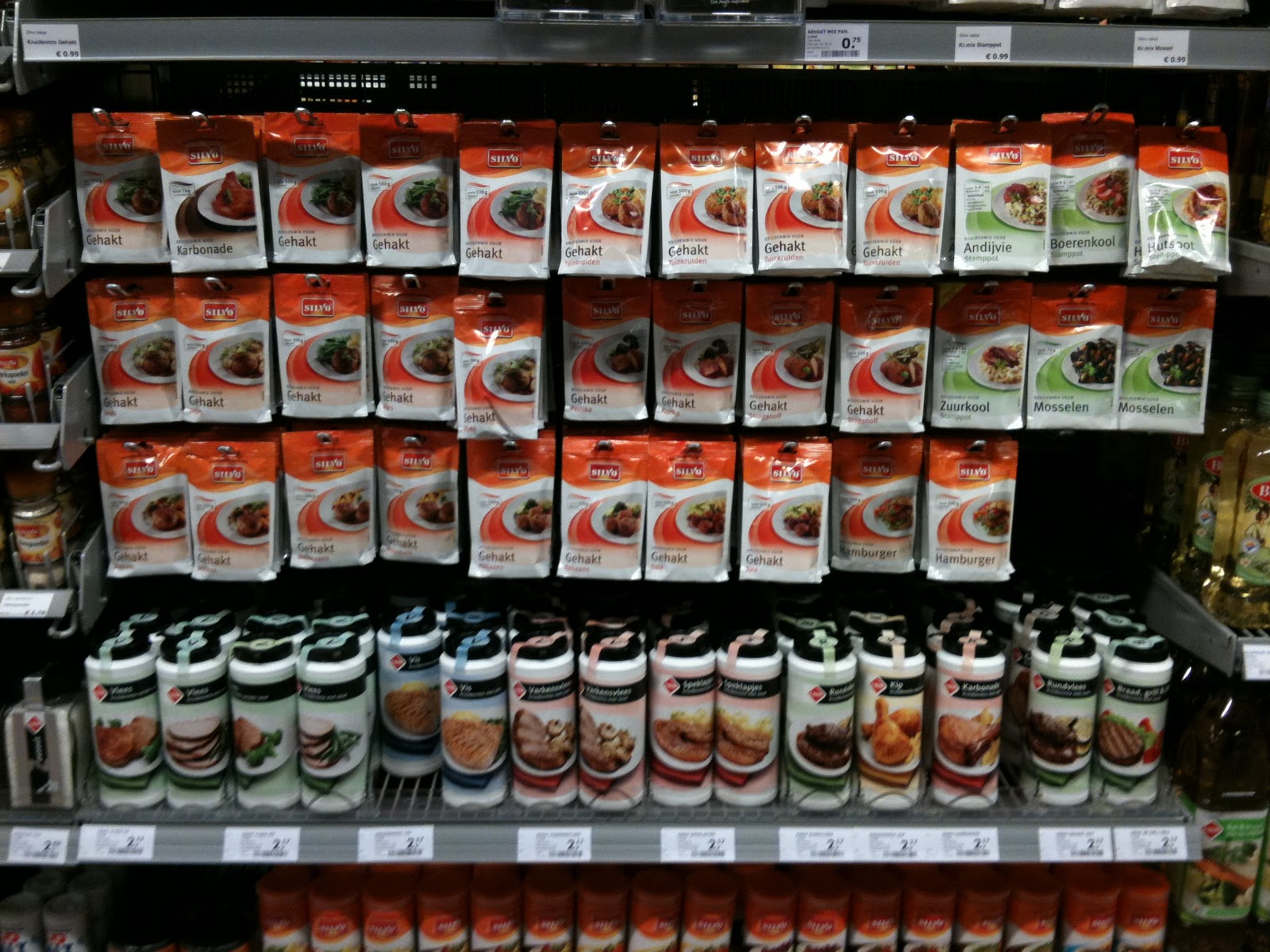
Seasonings: you're making meatballs? Use meatball seasoning. Making chicken? Use chicken seasoning? Fish seasoning, beef seasoning, pork seasoning.... the specific seasonings come in much bigger packages than individual spices.

Sauces and dips: mostly mayonnaise and ketchup. But ketchup and mayonnaise are used much more as dips than as ingredients. I think all those big white bottles are different kinds of mayonnaise, that are used for different things, or with different flavours. There is also a lot of garlic dip and garlic sauce here. Sometimes, you even dip cheese into a dip! Cheese becomes the base, and the dip adds flavour. I still can't get my head around that one.


Butter and substitutes: I can successfully distinguish between real butter with salt, unsalted, and margarine (halvarine), but there are a lot of other butter substitutes that I can't figure out (well, I haven't put much effort into it yet.) I know that one of these products looks like butter, but you use it to make gravy. You put about 1/4c of this "chroma" into a fry pan, once it's melted, add the meat, then as it mixes with the juices, it makes some kind of gravy-like sauce. I'm still not sure what I think of it. But I think some of these products could be treasures... could be. Although, I'm a little nervous of a butter product in a squeeze bottle.

Frozen veggies: these three doors are the entire frozen vegetable section. This may be what I miss most! It's mostly spinach, beans and peas, with some mixed vegetables... but even those are different. Oh.

Potatoes: I totally forgot about the well-loved potato! There is always a large selection of potatoes in any grocery store. Of course, you can get your 5 kg bag of potatoes (I get mine for $1.50 Euros), you can get smaller amounts, OR you can get fully washed and peeled potatoes, in almost any size, packaged like pre-washed lettuce. The frozen potatoes (mostly french fries) take up more space than all of these frozen veggies combined.
Welcome to my world of adventures in the kitchen!
Not really... I can find almost everything in the grocery stores (except chocolate chips, catalina salad dressing, thin salty bacon, and dry mustard), but there certainly is a difference in how some of the products are packaged, stored and prepared. There's a difference in variety, and what products have a lot of competition- which leads to a difference in price. I think this is the main contributor to food, meal and menu differences between the Netherlands and Canada.
Get ready for lots of pictures from the grocery store I visit most. Please excuse the pictures... I didn't want to be noticed as I was documenting my shopping trip, so I didn't pay enough attention to the quality.
The produce is mostly the same- except it comes in smaller quantities here.
Breads: you can buy fresh breads at the local bakery, at the bakery section in the supermarket, or you can buy partially-prepared bread products like these. Ciabatta buns, french baguette, rolls, pitas-- whatever you'd like, in a sealed, airtight bag. Store it at home, then put it in the oven for 4-15 minutes (depending on what it is), then you have fresh bread!

Canned vegetables: green, red, brown or white beans, carrots, corn, peas, peas & carrot mixture, beets... I'm sure these are all in stores in Canada too, but based on the size of this store, I was surprised to see such a large variety of canned veggies.

The baking section: this is the entire baking section (except sugar and cinnamon are found elsewhere). Icing sugar is used to sprinkle on top of fruit bread, oliebollen or other breads, so it is sold in shakers, not bags. I bought 3 different kinds of what I thought was "brown sugar" before I got the right one. Flour only comes in bags of 1000g (that's 1 kg... no bigger). Vanilla only comes in bottles of 38 mL, and I have only found 3 other artificial flavours between the 3 big supermarkets in town (almond, rum and lemon). They're all made by the same brand so no competition for price. I couldn't find rolled oats in this supermarket, but I found them at two others-- in 500g bags, no bigger.
I'm not sure what came first, a very small variety of baking supplies or a very small amount of people who bake. In any case, I think it's a special thing to have homemade baking here.

Alcohol: the wine and beer section is bigger than the fruit juice section. And they sell beer with 0% alcohol.

Cereals: this corner is the entire cereal section. Complete with Corn Flakes, Special K, Bran Flakes and Muesli (or Cruesli). No Rice Krispies! Look just beyond the cereal though...

Chocolate toppings: chocolate spreads and sprinkles, made to top off your breakfast toast, or add some flavour to your lunch-time sandwich. Milk chocolate, dark chocolate, white chocolate, shavings, sprinkles, spread, or combinations... there are even pink ones (I think they're fruit-flavoured.... more healthy?) Notice the number of different brands, and the fact that this is not the whole section (top shelf is cut off).

Deli meats and cheeses: yep this whole aisle's fridge is just meats and cheeses. Smoked sausage and Gouda cheese are staples here.

The "International" section: Well, I think it's more like the Mexican section, with some Thai. The bottom shelf has the only tortilla chips in the store, and up higher there is one can of mild salsa and one can of hot salsa. No brand competition, so this is much more expensive than salsa in Canada.

Canned meats: on the left of this shelf is canned meatballs, and on the right is canned hotdogs (knacks). Dump the can and the liquid contents into a pot, turn on the stove, heat up, and ta da! I think these are eaten (with mayonnaise and ketchup and other sauces) like we eat chips and salsa or chips and dip.

Oil and vinegar: this is mostly for the oil... apparently there are lots of different kinds of oil, that are for different kinds of deep-frying?

Seasonings: you're making meatballs? Use meatball seasoning. Making chicken? Use chicken seasoning? Fish seasoning, beef seasoning, pork seasoning.... the specific seasonings come in much bigger packages than individual spices.
Sauces and dips: mostly mayonnaise and ketchup. But ketchup and mayonnaise are used much more as dips than as ingredients. I think all those big white bottles are different kinds of mayonnaise, that are used for different things, or with different flavours. There is also a lot of garlic dip and garlic sauce here. Sometimes, you even dip cheese into a dip! Cheese becomes the base, and the dip adds flavour. I still can't get my head around that one.

Ketchup and mayonnaise even come in tubes.

Butter and substitutes: I can successfully distinguish between real butter with salt, unsalted, and margarine (halvarine), but there are a lot of other butter substitutes that I can't figure out (well, I haven't put much effort into it yet.) I know that one of these products looks like butter, but you use it to make gravy. You put about 1/4c of this "chroma" into a fry pan, once it's melted, add the meat, then as it mixes with the juices, it makes some kind of gravy-like sauce. I'm still not sure what I think of it. But I think some of these products could be treasures... could be. Although, I'm a little nervous of a butter product in a squeeze bottle.


Potatoes: I totally forgot about the well-loved potato! There is always a large selection of potatoes in any grocery store. Of course, you can get your 5 kg bag of potatoes (I get mine for $1.50 Euros), you can get smaller amounts, OR you can get fully washed and peeled potatoes, in almost any size, packaged like pre-washed lettuce. The frozen potatoes (mostly french fries) take up more space than all of these frozen veggies combined.
Welcome to my world of adventures in the kitchen!
Subscribe to:
Posts (Atom)